
(Fan Art credit to Harglvan on Deviant Art)
"Who am I? You sure you want to know? The story of my life is not for the faint of heart. If somebody said it was a happy little tale... if somebody told you I was just your average ordinary guy, not a care in the world... somebody lied.."
SPOILERS ALERT FOR ALL 3 FILMS. YOU HAVE BEEN WARNED!
There is no doubt we are living in a superhero dominant society. Basically the superhero genre in media is arguably the most popular genre of the last 20 years, with providing so many films and tv shows that has won over the heart of millions of people and are crushing it at the box office/ TV ratings. Even dating things back to the likes of films like Richard Donner's Superman and Tim Burton's Batman, and tv shows like "Batman The Animated Series", and how the success of projects like those have spawn the successes of other superhero properties in media throughout the last 20 years. Such as Christopher Nolan's dark and grounded "Dark Knight Trilogy", the ever ongoing Marvel Cinematic Universe, and tv series such as "Daredevil" and "Invincible", and while I wound't considered most of them high art, they are mostly entertaining pieces of media that filled with great characters, fun storylines, and some sparks of creativity and effort behind them, and often don't negativity affect anyone quality wise (business wise on the other hand is a different story for a different day).
However, I don't think any of the success of the superhero landscape we have today would happen if weren't for one superhero trilogy in particular. One superhero trilogy that not only got more people introduced to one of the most beloved characters of all time, but also opening the door for new and exciting opportunities that could change the superhero landscape forever. As well being one of the most visually exciting, creatively directed, and personally moving film trilogies of all time. Of course, I'm taking about the one and only "Spider-Man Trilogy", directed by the one and only Sam Raimi and stars Tobey Maguire as the shy and dorky yet kind hearted Peter Parker and friendly neighbor Spider-Man. That's right, I love this trilogy so much, and we're gonna talk about why. Also there will be spoilers for all 3 films in case if you haven't seen them. Just a heads up. So let us begin.

(Pic credit to Sony Pictures)
Now in order to under why the Raimi trilogy works so well, I got to take you back to when they were first made. You see back in the late 90s, the superhero genre was kinda at an all time low, and a lot of people stop taking them seriously because the films were labeled as jokes thanks to films like "Batman & Robin" and "Steel" being not well received by critics and audiences. They performed so badly that no one wanted to see any more films featuring super power beings taking on bad guys anymore. But as we all know, it wasn't the case, as films like "Blade" and "X Men" came along and proved that superhero films can still be very good and there is still an audience out there who want to see super power beings taking on bad guys. However, they didn't create the same cultural impact that first "Spider-Man" created. As not only was it loved by critics and audiences alike, but it was a massive success at the box office, with the film making more than $114 million on its opening weekend, which at the time of its release marked as the biggest opening weekend of all time.
The success of that first film not let to the success of the next two installments, but also launched of a new wave of superhero films that tried to replicate the spirit and heart that first film while totally missing the point of what made it so great to begin with. With films like "Daredevil", "Catwoman", and "Fantastic Four" tries to emuliate the style and heart that Sam Raimi managed to achieve with his Spider Man films, but failed pretty badly. This trend would become the norm for superhero films until Christopher Nolan came in and changed the game with his "Dark Knight Trilogy" and then lead to the cinematic connections the MCU has reign over the blockbuster norm in the last 15 years. But back onto the Raimi "Spider-Man Trilogy", I don't think so much of the success of the superhero landscape wouldn't be on the level it is today if Sam and everyone involved with this trilogy put all their heart, soul, and mind into making all 3 films as creative, as wonderfully cheesy, and as emotionally moving as they are in order to capture the core aspects that made Spider-Man, Peter Parker, and his world so exciting and retable to million of readers across the world onto the big screen. So let's talk why.
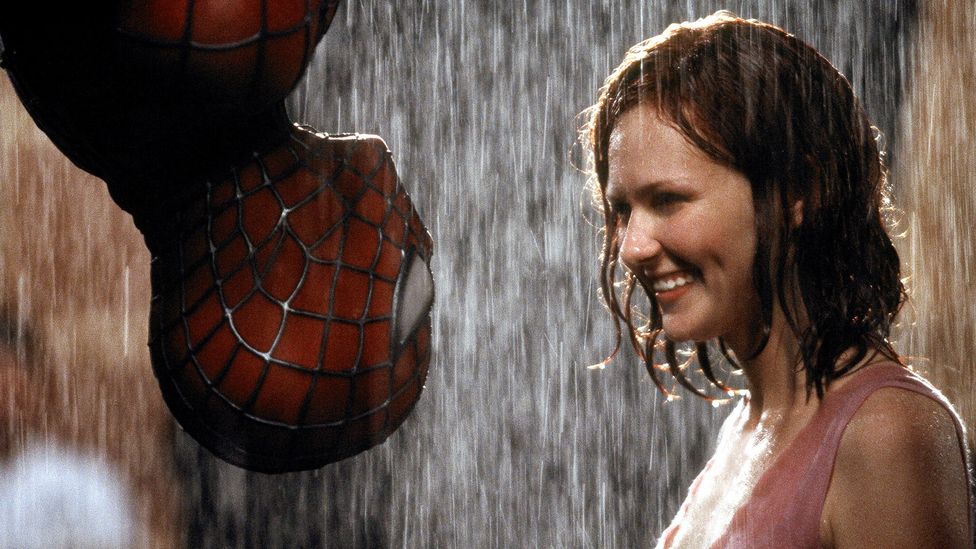
One of the best aspects of this trilogy is how it's committed to its simplicity within its plot and tone to match in line of the comics and other interruptions of the character that has come before. If one would sum up the basic plot of the trilogy in one sentence, it be like "A young, shy and dorky kid gets bitten by a spider, get's spider powers, and trying to stop the bad guys that came along his way, all the while trying to be the girl of his dreams and learning more about what it means to be a hero.". That's as simple as it can be and it's such a perfect spring board for people follow along and don't need a bunch of unnecessary add ons to make the plot more complicated than it needed to be. Because as the old saying goes, the more simple your plot is, the more opportunities you can dive into the complexity of your characters, themes, world building, and filmmaking, and as we dive further into this essay, this whole trilogy succeed in all of these levels and more. Not to mention that they aren't ashamed into complete camp and cheese within the tone and dialogue that it doesn't come across as cringy, but rather adds to the excitement and joys of watching these films and making you feel like its a comic book coming to life. Not just within the characters, but also the filmmaking and style behind it.
That cheesy and campy tone can really only come from one man who understands it better than most people, Sam Raimi, Now my boy Sam knows how to make over the top camp work with precision and care, and he shows how he's a master of it throughout his filmography. From "The Evil Dead Trilogy", to "Darkman", to "The Quick and the Dead", he's always knows to how to make the cheese factor feel so earnest and have its charm that makes you more engaged within the film through his use of fast pace zoom in close ups, the weird transitions, in person camera moments, and over the top action that plays into ridiculousness but also tapping into a mixture of horror and raw brutality to make them emotionally engaging while also going full bonkers mode that only a few other filmmakers can achieve. And all of his significant quirks and styles are all present in this trilogy.
Raimi went all out with providing such a unique style, vibe, and look that stayed true to those original Stan Lee and Steve Diko comics, while also trying to make something that feels like its own identity in the process. Unlike a lot of adaptions where they feel so ashamed of the source material at hand and they tried to be something more "realistic and grounded" (which is also in terms of sucking the soul and personality out of the material in favor of being dull and lifeless), the Raimi trilogy is not ashamed of the source material at hand, and he make sure that everything is in service to get you into the obscure and over the top cheesy aspects while keeping them realistic and grounded as possible.

(Picture of Sam Raimi working with Tobey Maguire and Kristen Dunst on the set of "Spider-Man 1")
The trilogy brings along aside some truly incredibly talented creative artists who helped Raimi in getting his take of the wallcrawler to life. Including cinematographers Don Burgess (who shot "Spider-Man 1") and Bill Pope (who shot 2 and 3) who gave each film such an unique and vibrant look that's more in line with their attention to detail about getting the intimacy of a human faces with countless close ups and long takes to sink in the emotions they are feeling at a particular moment especially when Raimi wants to get into the head of the characters) and the variety of colors (including, but the not limited to, the golden hour look of yellows and oranges that we have started to associate with Spider-Man) that allow to have every scene have a singular look and feel to them. Which the combination between the colors and camera movements demonstrates on how to capture brillant visual storytelling, conveying whats happening in a scene without dialogue giving those information to us. Whatever its through a thrilling action sequence like the final fight in 1 (which that stuff I will touch on later) or a quiet and intimate scene like Peter telling Aunt May about what happened to Uncle Ben in 2, Raimi and the DP goats of both Bill and Don throughout the trilogy do everything they can to make every emotion shine not just through the perfomances and dialogue, but through the camera tools around it. Because film is a visual medium, and by using the camera to help give you a clear look and understanding of what you're doing, it makes it feel more alive and cinematic than an high budgeted SNL skit most blockbusters face with today. So use all the tools.
Also you got to give shoutout to Raimi's long time editor Bob Murawski, who was credited as the editor for all 3 films (along with Arthur Coburn on the first film) and knows how to make every scene in each of the 3 films to have the right amount of pacing, unique sense of style to them, and cuts within a scene that makes every emotion count no matter how crazy or simple they are. No scene overstays their welcome nor they're cut too short, every scene serves their purpose and themselves. It's stuff like this to allows both Raimi to go all out with his style (like how the train fight in 2 starts with Spidey swinging before seamlessly transition to a reflection in Doc Ock's glasses, like that is cinema) and the actors to let their performances to shine through within those long takes that knows when to cut when needed (like Peter and MJ's first real scene together in the backyard of their respective houses that allows the long conversation to play out and cutting to get different shots to show how the two are getting closer with each other). Editing is more than just cutting back and forth, its about rhythm, pace, and understanding when to let things be what they are, and only cutting when its needed to. Not to mention the killer transitions that Bob and Arthur added to fit within Raimi's vision throughout the trilogy so well (one of my faves is the transition from Norman as Goblin blows up the headquarters of Quest Arrow to the graduation hats being thrown in the sky in the first film). Killer stuff.
You also got composers Danny Elfman and Christopher Young to create such iconic and incredible scores that makes my ear drums filled with delight, excitement, and tenderness that can also add to how can tell a story without dialogue at hand. Like if you take out the dialogue and just you keep in the score, you still feel every sense of emotion and punch of every moment in these films, and that's because of how they grip you into the story with their musical cues and how they naturally build through out it. I mean by God, those first notes of that opening theme in each film (especially in the first film) just gives me a sense of goosebumps, and waterry tears ready to stream down my face even before the tile card pops. From those opening scores, each film establishes how they feel their own big events and not just another installment in a series, while keeping themselves within the spirit of the same series. I also love how each opening has kept the same theme while also incorporating interesting stuff that makes them stand out. Like with "Spider-Man 2", they incorporated the theme for Doc Ock in the middle of the reuse of the classic intro theme, and with "3", they added the theme for Venom to contrast the heroic theme as something dark, evil, and monstrous tone to creep into our ears before the heroic Spider-Man theme comes back and fights it hard. Like its so good. And you got to give both Elfman and Young the praise for making music that is iconic and memorable to listen to, as well adding to the experience of watching the film more moving and exciting.
The praise for the behind of the scenes stuff doesn't end here. I need to give a shoutout the hundreds of hundreds of amazing talents that goes within the production design, the costumes, and the visual effects department. Every set piece (not just in terms of the action sequences) has their own unique look and feel based on their purpose within the film and how they can have their own sense of character without even having someone in that set piece. Whatever its within the messy child like bedroom Peter has in the first film, or Peter's crummy apartment in 2, or even the chaotic crowdness of the Daily Bugle, every set and location in the trilogy feels iconic. Not only because they made the sets practical as they can be, but they feel like places you either recognized or have been to/lived in. They all have their own voice and place that feel like anyone can walk, run, and shown towards, and they even share a lot about certain characters as well. Like Aunt May and Uncle Ben's house feel cozy and warm that reminds you of visiting grandma and grandpa's house, and shows how May and Ben gave the love and warmth they have towards Peter. Compared that to Norman's house, its grand and huge yet so lifeless and isolated and having an atmosphere that is unsettling for anyone to live in. You see what I mean how a set can convey so much about a person and what do they mean to the story without having people attaching to it, This is all thanks to the amazing production and set design team who put dozens and dozens of hours in making sure every set feels real, tangible, and having a heavy amount of personality/character towards them that makes every scene and moment in this trilogy feel memorable both in the slower paced scenes and the scenes where tons of crazy action happens (don't worry, I will get to the action in a bit).
It should also be noted that the costuming and design for the characters and suits are great for the type of film this trilogy is. The Spider-Man suit here is one of my favorite recantations of the iconic suit, and that because the texture and molted of the suit feels tangible and flexible that makes you feel that someone can wear it and be in stiffed within the way it evolves throughout the films, while also showing that it can be wrapped and destroyed to get the impression that a human being is wearing it and for the most part, it looks unbelievably real instead of being a CGI character that came out from a Playstation 2 game. The suit and costumes also works great when discussing about the villains. Giving them each with their own look and feel that is still true to those classic comics while also incorporating their own look and feel to them as well. Whatever it might be the the Power Ranger like suit for the Green Goblin, or the nearly comic accurate look of Doc Ock (top with real movable arms that blends CGI and Practical effects perfectly), the villains look and costuming fits perfectly within the cheesy and censure tone and feel of the trilogy, and how they feel like a real person wearing these suits much like the hero is.
Also this trilogy is a masterclass when it comes to blending CGI and practical effects perfectly, allowing for both Raimi and the amazing VFX team lead by the great John Dykstra (which his team won Best Visual Effects at the Oscars for the second film) to work together and find the areas when the more closer and grounded feel of the action and spectacle when it needed to done practically to make the obscure tale as grounded as possible, and for the CGI to shine through when something more crazy and visually operatic happens. As well as doing something clever that most cape flicks don't do, end a CGI shot with a real person behind it. Like for example, during a scene in the second film where Peter lost his powers as Spider-Man, it starts with a CGI shot where he's falling within CGI looks and movements, but then Raimi quickly cuts to Tobey in costume. Such a brillant way to show how even with the amount of special effects you have, if you don't cut back to realness and humanity behind it all, then these heroes will become nothing but a fireworks show.

(Picture of Tobey Maguire with his destroyed suit on the set of "Spider-Man 3")
Speaking of realness and humanity, let's talk about those aspects that are present within the trilogy. Because talking about the amazing direction and craftsmanship behind the scenes, would have added up to nothing if the story, characters, and themes within the trilogy are trash. But thankfully, they aren't trash. If anything, it's what evolve the trilogy from every other comic book film before and after hand, and make them something special, something memorable, and something timeless. Like I said before, the trilogy is unashamed with embracing its cheesy, corny, and over the top tone and feel of the classic 60s comics with its dialogue (like "Aunt May, Aunt May. Is that an angel?" or "Its you who's out, Gobby. Out of your mind!" or "Punch me I bleed" or "Im the sheriff around these parts." as examples) and the way characters react to any situation (like Tobey is like the king of meme faces). But underneath all of that, there's a real intimacy with its story, characters, and themes that makes it honest and relatable to the human experience. Probably more than any other superhero film that has come before and after.
Each of the 3 films have very simple and easy follow plot to follow as I mentioned before (even with the amount of plot lines and characters in the 3rd film, it's still easy to follow through for the most part). But what makes them deeper and complex underneath the surface is the way the character work and themes that drives the story. I think the complex and relatable characters and themes is what evolves this trilogy from being another generic trilogy to being one of the all time greats not just in terms of the superhero genre, but in general. Its so good that most of the time when I think about this trilogy, I just don't think about the action sequences, but I also mostly think about the moments in between those action sequences. Those moments where they can focus on the characters themselves and have them interact with each other and face struggles that are real, honest, and relatable for anyone to connect with and to me, those moments are just as exciting and moving to watch as the scenes where Spider-Man is webbing up bad guys. This went to the point where I personally view this trilogy more as a human drama with superhero elements in them, and that's because of how Sam and company really put their focus on character over an effect show throughout all 3 films. So let's talk about who are the characters in detail, and what made them so great.
(Pic Credit to Sony Pictures)
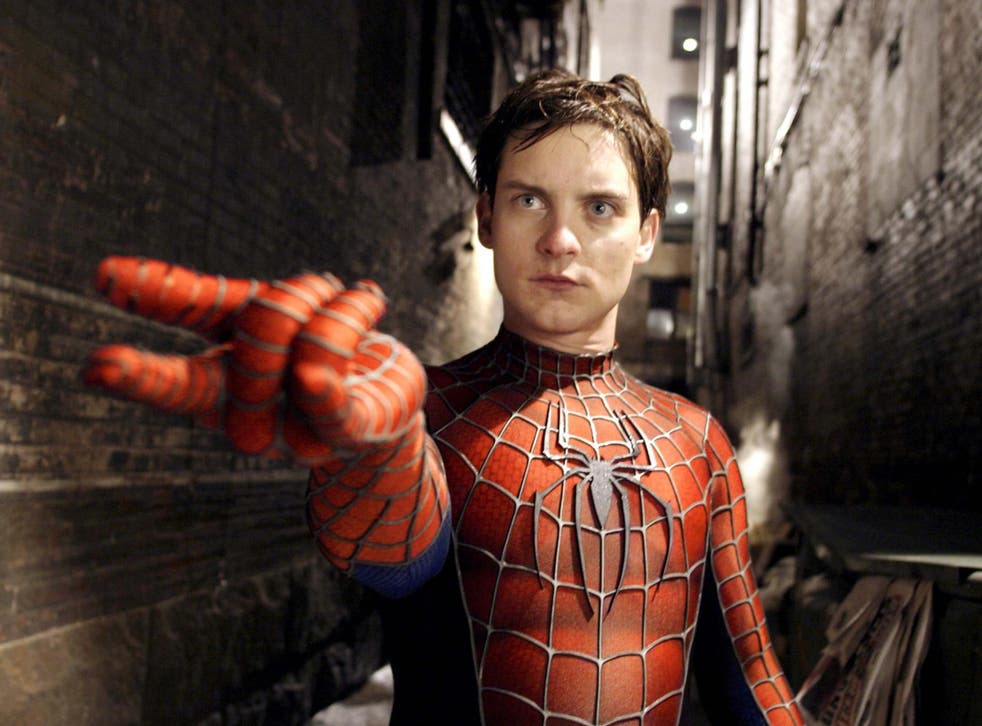
Let's start with the tile character himself, Peter Parker, also known as Spider-Man. Now before I continue, let make me one thing perfectly clear. I like all 3 actors who have taken the role of Peter Parker through the years. Tobey, Andrew, and Tom have all done a great job on taking their own unique spin of the iconic webslinger while honoring the legacy that came before. I mean part of the fun of "No Way Home" was just seeing all 3 Spider-Men together and seeing how all 3 of their own unique personalities bounce off with each other. But even with that, I will say that, while I think Andrew is probably the best actor for the role, I personally feel the most attached with Tobey's take on the character. Not because he was the first to do it, but I feel like he's the most fleshed out and most relatable out of the 3 actors. The reason for it, is because we get to see like the complete cycle of his life through the 3 films.
In the first film, we see him grow from the shy and awkward nerdy kid who got bitten by the spider and goes through many trails and sacrifices (like having his uncle getting shotted, fighting the Green Goblin, and rejecting to be in love with Mary Jane Watson) in order to become a man who learns what it means to be a hero with great power and responsibility. In the second film, we see Peter struggling with his Spider-Man life because of how it's constantly ruining everything in his normal life (like jobs, schools, relationships, paying rent, and broken promises) that he eventually gives up being Spider-Man, before learning that being a hero is more than just a mask and thus dawns the suit once more while understanding that doing the right thing means you might have to give up what you want in life. And in the third film, Peter has achieved the life he dreamed of (that having both the Spider-Man and Peter Parker lives working as a dynamic pair), but throws all of it away due to him being filled with ego and pridefulness, and becoming an asshole to everyone he loves and anyone who comes in his way (not to mention wearing a suit that came from an alien life form doesn't help), and once he realized all of it, he throws away that toxic nature away and dawns the good hearted self to him again and learning to forgive others and himself for the mess he caused.
We all have been through those stages of his life... Okay, maybe not the spider bitten and getting spider powers part, but the mundane and tough parts of Peter's life are something that we as the audience can relate to. We all have (or going to) experienced times when we were happy, when we were angry and sometimes horrible, when we were trying to balance so much in our lives, when we were trying to find jobs to pay rent, when we try to maintain good relationships, when we were longing to be with the special someone who will love us forever, when we're trying to achieve whatever goals and dreams we have in our lives, when we are battling within ourselves and trying to do the right things for ourselves and for other people, even when its hard. We have all been there (me included), and I love how Sam, Tobey, and screen writers David Koepp (who wrote the first film) and Alvin Sargent (who wrote the second film and helped co wrote the third with Sam and Ivan Raimi) weren't afraid to depict the real and struggling life Peter has faced with throughout all 3 films, and how his normal life can be as messy (if not more than) as the life where he wears a spider suit and fighting bad guys while being the hero for the city of New York.
I feel like it was something that was missing from Andrew and Tom's outings for the most part. Not to say that they didn't have their moments of reliability and internal struggles within them (they sure did), its just for me at least, their respective series of films were either trying be conformed by the studio's need to set up a cinematic universe of their own and block anyone else who tries to handle the character with Andrew's films or trying too hard to be more Disney Channel like style of humor and tone to be added a familiar looking and tonally consent universe before shifting things to be mostly dark within the last film for Tom's films. It's like those films get caught in a web run by studios who care about keeping the IP of Spider-Man alive, and not focus enough of the deep and gritty side of things in terms of exploring the character of Peter Parker. I'm not saying Andrew and Tom are bad Spider-Men (like I said, I like them as their respective roles), it's just like their films for the most part didn't get into the full potential their characters should have when it comes to dealing with the more struggling and relatable life he always faced with like in the comics. Well, at least for me that is.
But with Tobey's films, it feel like we get the whole picture of his life, and his highs and lows both as Peter and as Spider-Man in the most authentic way the films can show. Even if its not the most comic book accurate take of the character, they still were able to nail the core aspects of who Peter Parker is, and how both of his lives can be both exciting and hard yet relatable for the viewers to get attached towards. As well as having him trying to keep that lovable, dorky, and kind hearted side of his character presented in the films, with Peter struggling and suffering greatly and even having moments stepping the dark line too far (like all of the shit he did for the first 2/3rds of the third film) to show how imperfect he can be at times. Which can be uneasy to watch at times, but Sam, Tobey, and company always made sure it was done in a way that is grounded and realistic, which is saying a lot about films that feature a guy who has spider powers. It's absolutely perfect.
I know that a lot of people have criticized Tobey for being "too old" for the role and such. But for this take of the character being less total teenager and more of a young adult who is transitioning from childhood to adulthood while dealing with the fact he was bitten by a spider and dealing with so much loss because of it, I think Tobey does nothing short of amazing with how he was able to capture every sense of emotion he can convey with both as Peter Parker and Spider-Man, no matter dorky, cheesy, sinecure, or even memey it can be (which btw, the Tobey memes on the internet is my bread and butter for life). He, Sam, David, and Alvin deserves all the praise for making take of Peter Parker so true, honest, and vulnerable that we can get invested towards no matter within the action and non action sequences, but is a take on the character that is true to the original intention Stan and Steve always has imagined within the character and why he has spoken to millions of fans across the world. I just love him so much.
So let’s shift our focus to Kristen Dunst as Mary Jane Waston. Oh boy yeah, I have a lot to say about her, and its pretty much in all of the most positive ways possible. Because there has been a lot of hate for her throughout years and I'm just tried of it all. Now granted, I kinda get some of the criticisms like she's often a damsel in destress and stuff like that. But I have been hearing people complaining that "She's not a character" or "She's only just to be the hero's girlfriend" or "She's nothing but a mean, self control bitch" for years. Now look, I normally think that those who think differently than my opinion should allowed to have their own opinion and not telling them they are wrong. But in this case, I can safely say:
*T'Challa voice: "You are WRONG. ALL OF YOU ARE WORNG!"
Because I personally think that this take on MJ is fucking great character and she deserves more praise and love than what she is given. So yeah, lets talk about her in great detail shall we?
When we first see MJ, she was someone who was shown off as the shallow pretty girl for guys to flock over (I mean Peter in his narration sates that she was the woman he fell in love with before he even liked girls) and tries to be happy and go lucky all the time. But deep down, she's feeling unhappy and not loving herself because of how much abuse she faced with in her life by her father and how the guys she dated in the first film (Flash and Harry) don't really see her. And that's part of how MJ acts when she's out with other people. Justing putting on a mask to hide her inner pain, because no one wants to see her. Sure they want to see the ideal her, but not the REAL her. That's part of the reason why she wants to become an actress, because it will give everyone a chance to see who she really is through something she loves, even with so many people just made fun of her having that dream, because they never really see and understand who she is on the inside. But there is one person who DOES see her tho, and that's Peter. But he mostly get those moments from a distance, yet he still got a general sense of who MJ is really like under beneath all of the party girl persona she got going for, and never got to tell her in a one to one moment.
(Pic Credit to Sony Pictures)
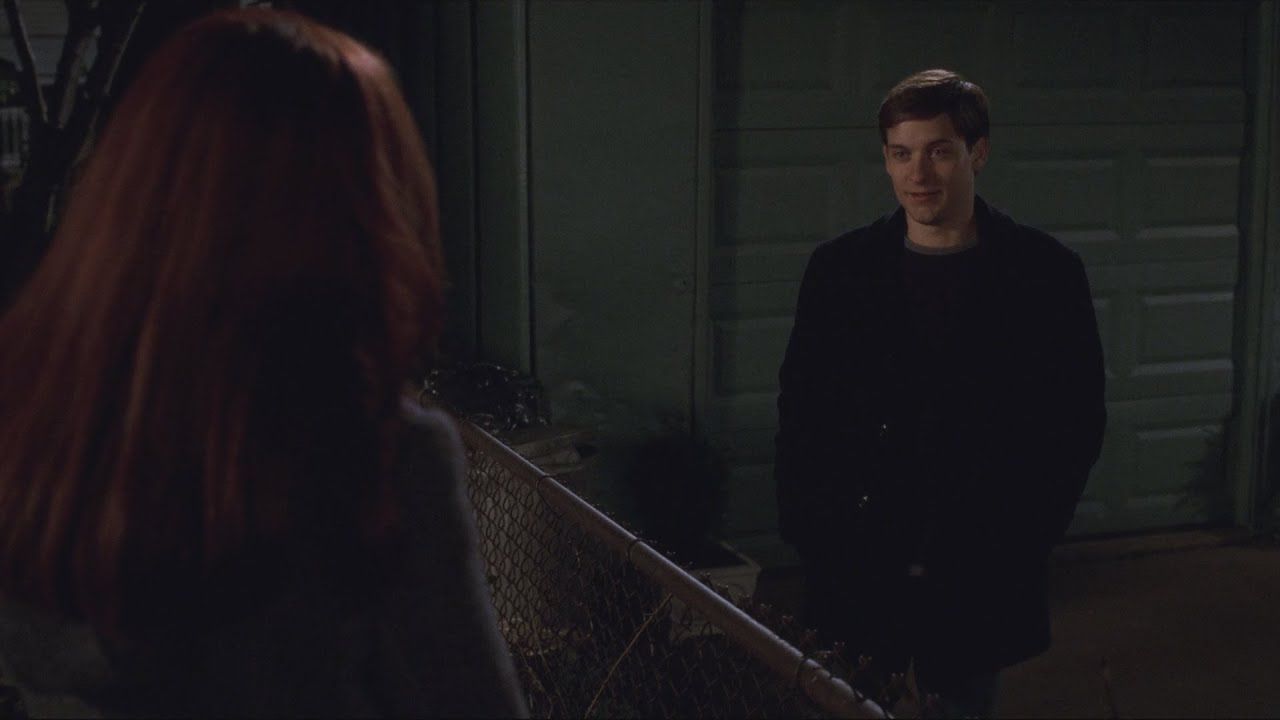
That is until that scene in "Spider-Man 1" where they're both in the backyards of their respective homes, aka the first time where they get to truly interact. The scene starts off with the two of them walking outside of their respective homes, with Peter taking out the trash and MJ getting away from her abusive parents for a brief moment. The two finally meet and start having a conversation that's more heart to heart than just being "wow you are beautiful" or "wow you're cool". It's starts off with typical icebreakers like "what are you going to do after High School" and stuff like that, and before MJ says that she wants to be an actress, you get a feeling that she doesn't want to say it because of how she was judged on when she mentioned it before, Even when she does say it, she mentioned in a non serious manner, like she wants to but in a not really sort of deal. But Peter's response to that comment with "Really? Well that's perfect." As he said that, there's a shock in MJ's face, because no one has ever told that before, and because of it, we can see two get closer to each other and for the first time in her life, she can be open to anyone without that feeling of being judged and eventually asked Peter about what he wants out of his own life (which Peter doesn't really know at the moment, considering this scene takes place after he got bitten by the spider that gave him powers, and was testing them out for the first time).
And because of this moment, MJ has kicked started off her arc that she's willing to be okay with herself and love herself for who she is. As well as coming to realization that she doesn't want to be with the guys who only see an idealized version of her (like with Flash or Harry), but rather being with someone like Peter, because he's the only person who has treated her with respect and feel like there's love and kindness within a world that has treated others like total garbage. Not to mention that she offers the same kindness towards Peter within their interactions throughout the rest of the film and because of it, it makes us the audience easily get invested into their chemistry and hopefully want them to be together by the end (which btw, if I had to sum up their chemistry, it would be adorably awkward). But as we all know, Peter rejects that offer of being in love with Mary Jane and just put her in the friend zone. It's a painful moment for the both of them, because not only does Peter have to put his love for MJ to the side because of his responsibility of Spider-Man, but also MJ have to suffer the feeling of abandonment and loneliness she felt throughout all of her life all over again. All because her best friend doesn't love her as much as she thought he does, and he can never tell her why.
This stems a lot within the 2 sequels (especially in the second film). As MJ have started to feel bit more anger towards Peter, because of how much Peter won't tell her what is going on and why they can't have that good relationship with one another. Even when she is tries to be nice and caring, it's pushing her limits and is tried with Peter's dishonesty and constantly broking the promise he gave to her (like seeing her on stage and be there when she needs him the most). So you don't blame her for calling Peter out for all the shit she put him at the planetarium party (which for Peter was the worst night of his life, as that whole scene was nothing but beat down after beat down for him) and refers to him as "nothing but an empty seat." Ouch.
MJ had enough of Peter's bullshit that she has "moved on" with another man, John Jameson (J. Jonah Jameson's son in fact) and got engaged to him the same night she told Peter that he's an empty seat, hoping that he would be the true genuine guy to be there for her in a way that Peter couldn't. But deep down, MJ is longing for that connection with Peter, because even tho she doesn't tolerate him now, he was the first person who saw her for who she is and is active in supporting the dreams she wants to have, and thus she tried her best to have a one for one talk with Peter and ask if he still loves her or not at a coffee shop. Which Peter replied with no, and even tho MJ is definitely heartbroken by the response, she asked him to kiss her to see if there's some form of connection between them. That is, until she gets captured by Doc Ock and Peter goes and rescues her once more.

(Pic Credit to Sony Pictures, and collage was done by yours truly)
But then, the two finally have that spark once more. As at the end of the final battle, MJ finally saw what Peter has been hiding this whole time. He is Spider-Man, and the look of relief both of them have is unmatched and so good like oh my GOD, ITS FUCKIN CINEMA, I CRIED. But what this moment shows is how Peter does love MJ, even when he said he didn't. But the conversation they have afterwards in where Peter tells MJ that even tho he loves her, the romance between them can never happen because of his responsibilities as Spider-Man, and even tho it broke MJ's heart once again, at least she can be settled and a bit understanding of what's happening instead of not being in the picture completely. But by the end of the film, she makes the choice to be with Peter despite of Peter telling her that she shouldn't be with him. Yet the thing is, it was never his choice to make, it was her's. Even though she knows the risks and challenges of it all (I mean the final shot of "Spider-Man 2" sums it up perfectly), she's willing to take those risks anyway, because she has finally helped out her best friend by doing the same thing that Peter helped herself with during that first conversation they ever had. Learning to love yourself and be open with who you are no matter what. Absolute poetry.
And before you people come out of nowhere and say "Oh actually, MJ only loved Peter because he was Spider-Man." Are you kidding me? MJ loved Peter for who he was, and it was Peter hiding that Spider-Man life from her that she hated because of how it was affecting their relationship in a negative light. She loved Peter so much that she's willing to live out the more risky stuff with Peter after hearing that he is Spider-Man. However, the whole "MJ hating Spider-Man part of Peter" aspect comes back in its ugly heads in the worst ways once the 3rd film comes into play.

(Pic Credit to Sony Pictures)
When we start "Spider-Man 3", we see both Peter and MJ at the happiest they will ever be. Peter is on the top of everything (both as Spider-Man and as Peter Parker), and MJ is finally living out her dreams of being an actress and is performing on broadway for the whole world to see. But more importantly, the two are finally together at last, and sharing the love they have for one another, including a beautiful scene where the two of them are looking up the sky on the spider web Peter made, and MJ tells Peter that she would spend the rest of her life singing on stage with Peter being there on the first, and Peter saying that he will be there. Like God, that scene is just so damm beautiful and its more romantic than most romance films in their entire runtime... Wait did I say that out loud? I did, so shut up.
But unfortunately, this high point of the romance doesn't last. As we see Peter being a self absorbed asshole for a good chunk of the film (which is pretty ballzy for a superhero film to take its main character who was established as good hearted and emphatic, and make him filled with pride and egoness if I say so myself) and doesn't value the importance of MJ as he used to. He gave her empty advice when he's helping MJ going through a tough job loss as an actress and didn't helped her cope with that loss, he went down and did the upside down kiss with Gwen in front of thousands of people (which was a kiss that was special to them and them alone), and is constantly pushing her to sideless in favor of his Spider-Man glory and eventually his vengeance towards Sandman for killing Uncle Ben. So you don't blame her for calling Peter out on the shit he has put her throughout the film (and the whole trilogy for that matter) and part of her wants to call it off with Peter and break up with him.
But those weren't even the worst things that Peter did to her in "Spider-Man 3" my friends, oh no no no. No the worst thing he did to her was taking Gwen Stacy (a girl he said meant "nothing" to him) to her jazz club job, interrupted her performance and humiliate her in the process, danced like a jackass, use Gwen as an object, and worst of all, he hit Mary Jane... Let me repeat that. Peter Parker HIT Mary Jane Waston. Yeah. Even after all these years, that moment still shocked me to my core. How can Peter do this to her? How can he take the woman he swore to protect and hit her? How can MJ see her first true friend can just do that to her in a physical manner?
Hitting MJ was the moment where Peter has finally realized that everything bad that has happened in the film, happened because of him. Hurting the woman that he always loved before he knew he loved girls is the breaking point where he needs to let go of his ego and pridefulness and make things right with her. Understanding MJ is heartbroken and hurt by what happened in that club, and has to make things right with her, because he has grown and understands that every action he makes has consequences, and is wanting to value MJ as the person she is always been. She's someone who loves Peter for who he is (flaws and all) and is willing to have her make the choice to wanting to be with him after everything he has put her through. The final dance they have at the end of "Spider-Man 3" showcases how MJ is willing to forgive her best friend and having a dance to signal how they mean to each other no matter what happens, and that makes me cry every time.
So I had a lot to say about Mary Jane and ultimately the romance between her and Peter, because I think this take of MJ is actually great and well defined that (while ultimately the not most comic accurate take of the character) makes her human and vulnerable. Sure she isn't perfect, but the trilogy recognizes that and spends a lot of time focusing on her to make us understand her situations and how she reacts to them. Not to mention Kristen Dunst does a great job in capturing the many sides of Mary Jane to make her more three demential than what she could have been, as well capturing the graceful beauty of what we imagine MJ is like in the comics (if you dont think so, its your loss, sorry). Not to mention I also buy how adorably awkward the romance between Peter and MJ is, and how the trilogy lays down the romance as young adults meeting and bonding with one another at the beginning of the story, and ending it off with two adults who has grown and build empathy towards each other after going through so much hardships and sacrifices they have to face in order to make their relationship work in some way or form. In short, I think MJ is a great character, and the romance between her and Peter is sweet, and Im tried of pretending that they're not. Anyway, let's continue.

(Pic Credit to Sony Pictures)
The trilogy is focus on 3 central characters. Peter Parker, Mary Jane Waston, and Harry Osborn. So let's talk about good old Harry. The character has been through a lot of interesting and compelling directions throughout the course of the trilogy, and in a way, you feel bad for the path he went through within the trilogy.
I mean the poor guy never had a good relationship with his father due to his father always never really gave him the love he deserved. So much that he when introduced his dad to Peter, he introduced his dad as "Norman Osborn" to show how they don't have the best communication when it comes their father and son relationship. Even when Harry graduate from high school, his dad came up to him and said "You made it. It's not the first time I have been proven wrong." Like damm. You can feel so sorry for Harry, as Norman never gave Harry any form of praise and recognition for who he is, and would rather value Peter as the son he never had than his actual son, and would give Harry shit for nearly everything he does (including insulting MJ when she and Harry were dating in that amazing Thanksgiving scene in the first film). This can be interpreted as a metaphor for emotional abuse between a parent and a child, and how the constant abuse from the parent can ultimately do some psychological damage towards the child as they get older, and make them feel unloved within themselves. Harry even has some of anger and resentment issues that he took from his father, and tries to control it down with his more "money filled" persona when he's talking to Peter about finding a job or when he's dating MJ. Partly because he really cares about the two individually and doesn't want them to be in any sort of danger that could affect them in any way.
But that all changes when Norman got stabbed by his glider and Harry saw Peter as Spider-Man (tho he doesn't know that Peter is Spider-Man yet) putting his dead father on a couch, grieving over the death of him, and set his mind on killing Spider-Man, a path that will affect his life throughout the next two films. But he still has a love and respect for Peter, and values him as a great friend. But that didn't last very long, did it? As within the second film, Harry starts to resent Peter because of Peter's loyalty of Spider-Man, and not to him. Constantly dismissing Peter for everything he does, and allowed his vengeance for Spider-Man get the better of him. Even tho deep down, he still cares for Peter and doesn't want him to get hurt (it was even shown in a line of dialogue shortly after making that detail with Doc Ock that he will bring him the Tritium Ock will need to rebuild his machine, in exchange to give Spider-Man for Harry to kill him), because he still views Peter as someone he truly cares for and is that one person that can bring him down from the driven vengeance he has with killing Spider-Man to get revenge for "killing" his father.

(Pic Credit to Sony Pictures)
However, Harry's nightmare came true. As he has found out Peter is indeed Spider-Man. All the hatred and anger he has been fulling for the last two years has taken a turn when he had found out that his best friend is also the superhero he hated for so long. And that scene was brilliantly acted by James Franco, capturing the sense of shock and confusion of who he just saw underneath the mask, and the direction of that scene being able to pull back to see the whole body reaction of how Harry was feeling during all of that is affectively chilling. All of it brilliantly showcases how much the relationship between Peter and Harry has changed big time, now that Harry knows Peter's secret and hates Peter even more, simply on the fact that he thinks that Peter who killed his father... or so he thought.
By the end of "Spider-Man 2", Harry starts to see a weird and crazy version of his father within the mirror of his mansion (Fun Fact: Willem Dafoe wasn't supposed to be in the film. He just came by to visit set one night on the way back to his apartment while they were filming and they offer him to make a cameo in it) telling Harry that he isn't really been gone and is alive in Harry, and now that he knew the truth of Peter's identity, Norman screams at him "AVENGE ME!". Which Harry responds with resounding "NOOOO!" as he throws his knife towards the mirror, symboling that he doesn't want to go through Norman's tactics because he even tho he might hate Peter for lying about his secret to him for so many years, he still cares about him and considers him to be his friend. But as Harry shaders the mirror glass, he notice a mysterious and unknown area past the mirror glass and he walks towards it, being unsure of whats lying ahead of him when suddenly, BOOM! The Goblin Mask Appears. Then Harry finds a stash of pike bombs the Green Goblin used and made him realized that not only is his father the Green Goblin, but he also left a stash of items and props for Harry to eventually find and take on the mantel of the Green Goblin once Norman has passed on. THIS is how you do a villain set up ladies and gentlemen (and non binary people), by giving your character enough conflict and depth into them before you make them the main villain, and it will give you the more freedom in creating an compelling hero and villain dynamic once you established both parties with equal weight and depth behind them in terms of individually and when they are on screen together. But how does Harry's transformation into villainy played out? Well, let's dive into "Spider-Man 3" to find out.
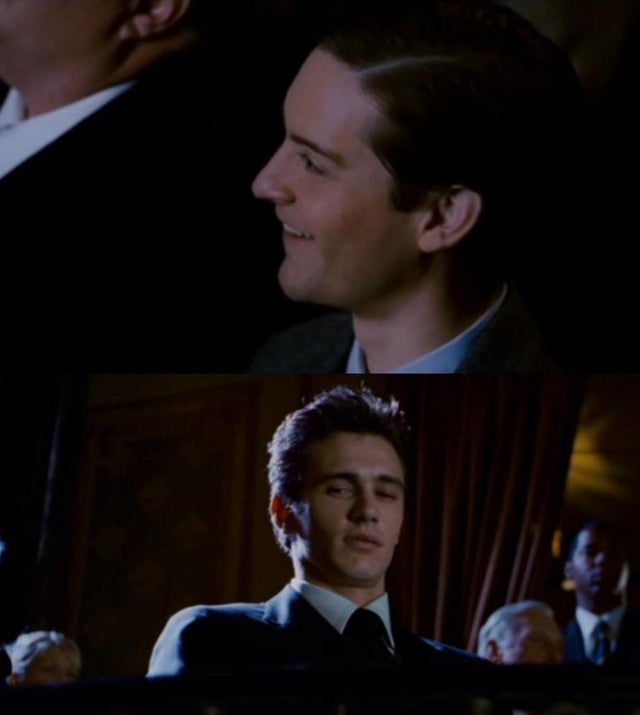
When we first see Harry in "Spider-Man 3", we see him giving a glimpse over Peter during MJ's play and he just gives a look of bitter sweetness towards Peter (which Franco just killed it during that moment), as you can see that he's still angry towards Peter about everything but the same time he can't completely hate him because he can see that Peter is the same good hearted boy he always known him as. But once this scene is over and we see start fuming the Goblin syndrome into his body the next scene we see him, it felt... well... interesting (?) to say the least...
Now look, I love "Spider-Man 3", probably a lot more than most people do. But one of my few drawbacks of it is that we never got to see Harry as the villain to its fullest potential, and that kinda sucks. It really does, because you can tell that Franco is clearly having an absolute blast playing Harry this time around (probably the most fun he had throughout the course of this trilogy), and the two fights he had with Peter are great to watch (even tho the CGI in the first fight can be a little effy in some areas), but because there's a lot going on the plot and a lot of characters to follow through (which I didn't mind as much, but more on that later), Harry's path of villainy is kinda shoved towards the sidelines for a good chunk of the film. Oh, and don't get me even started with the amnesia plot line and the way Harry restores his memory is just plan ridiculous. Don't get me wrong, I love the silly and cheesy and ridiculous nature of these films, but that is just too much man.
But even with how stupid Harry's amnesia plot line kinda was, the one aspect I do like about it is that I'm glad we got the chance to see is the moments that we see the more kind and down to earth side of Harry that was gone due to Harry's vengeance and anger towards Spider-Man (and extension towards Peter). Whatever it's the scene were he and Peter are goofing around with Peter's old basketball and trying to be friends again, or the scene where he invites MJ over to his place to comfort her after being let go from her show by cooking an omelet, dancing to "The Twist" and even sharing a play for her (something that our boy Peter couldn't do because his head is up his own egotistical ass to even care about anyone other than himself at that point of the story). It shows that despite all of anger and biter pain Harry has in him, he still cares about his friends and want to give them a sense of love and affection he couldn’t give to himself (or even being received from his own father). Even when he gets his memory back and after he got half of his face blown up by one of his grenades by Peter, he was able to let go that grudge he had with Peter and what happened to his father (after Peter stoped by and told Harry that they need to rescue MJ before kicking Peter out and found an old picture of the 3 of them together to remind them that Peter and MJ were always there by his side no matter what), and decided to help Peter to defeat both Sandman and Venom, while saving MJ.

(Pic Credit to Sony Pictures)
I mean come ON! That moment is just so great. I mean just seeing Harry forgiving Peter and seeing the two working together on both defeating the villains and saving MJ, someone they both cared and hurt throughout the course of the trilogy is just so damm great. Yeah it's cheesy and corny, but its 100% sincere in a way that most mainstream films these days wouldn't dare to accomplished. Not to mention in the moment Harry screamed "GO BUDDY!" as Peter leaps off from his glider and catches MJ before Peter web shoots them back at the end of the glider, that gives me CHILLS every time I watch it. But what really cemented Harry's growth and humanity is when Venom is about to kill Peter with Harry's glider, he steps in front Peter and takes the empalement for him. Which that moment is absolutely perfect, especially given the parallels his death is to Norman's death, in where Norman got empaled by given to his dangerous and harmful side and trying to hurt Peter. But Harry got empaled by given to his more empathetic and human side and trying to SAVE Peter. Poetry right there. Anyway, Harry concludes his arc throughout the course of the trilogy by being along side both Peter and MJ as he's about to take his final breath (which I should also add that it was a callback to a line earlier in the film where he recalls that he would give his whole life for them when he got woken up from his coma), and Peter opening up to Harry and say he's sorry for all he has put him throughout the course trilogy (and more particularly the stuff he did to him in the film). Which Harry ultimately forgives Peter, because he values him as his friend, which Peter valued Harry as his best friend back to him, and Harry gives his last breath and dies in his sleep. Having his arc throughout this from being a shadow and a tool for his father to shit on, to becoming someone who overcame that hatred and discrimination he faced into being a hero he never thought to be for his friends and ultimately himself conclude in a nice beautiful bow (all be sort of a messy one).
So yeah, I think Harry Osborn as a character is pretty great. The team could have made him as the one demential best friend turn enemy without any real depth or affective presence behind it all, but they didn't. Much like with Peter and MJ, they took Harry from the comics and give him so much depth and growth throughout the trilogy that's different from his comic counterpart yet still remains true to it all. You feel bad for him, as he was emotionally abused by his father and eventually get into a cycle of vengeance and hatred towards Peter for what he did to his life. But you end up rooting for him towards the end by getting out of that cycle and eventually being a hero of his own accords and rekindled the friendship he had with Peter (even if it's for a little bit), and I think James Franco does a very good job on nailing those complex and introspective emotions Harry had throughout the trilogy (tho I will admit that he is the weakest actor in comparison to the other actors within this trilogy), while incorporating some fun cheese into the role ("Its just like how she kissed me. That taste..... Strawberries."). Just all around, a great aspect of the trilogy that should get a lot more credit than it deserves.

(Pics Credit to Sony Pictures, and collage was done by yours truly)
Now as the old saying goes, for every good hero, you need a good villain to have them go up against, and oh boy yeah does this trilogy have a lineup of great villains to boast here. I won't go into a super in detail about every villain in these films, since nearly all of them have a lot of common and it will come off as redundant. But I still have a lot to say about them either way.
One aspect that makes them so compelling and interesting is that none of them aren't really villains to begin with. They started up as a regular human beings apart of Peter's normal life (whatever it be his best friend's dad, or one of his idols, or a jock who tries to get the staff job at the place he works at) and we get to know them in the same time span as Peter does before they eventually finding themself into the role of villainy that defend them throughout the rest of the story. Thus making the conflict Peter has with them (both physically and mentally) a lot more engaging and compelling to watch than just seeing a generic villain who just wants to take over the world and not have any form of a deeper connection with the hero until the third act in where they will go and fight in a big cgi battlefield that's empty and not interesting.
Not to mention that given Raimi's background in the horror genre, he was allowed to show off those roots in terms of how the villains are presented and how much of an actual threat they can be. Whatever it might be through Doc Ock's hospital scene in "2" or the brith of venom and the overall affect of the symbiote crawling up to Peter in "3" or showing Sandman's powers and ability to transform from human to a literal sandman also in in "3" or even something as simple yet effective as having the Green Goblin mask being a voice that can speak through Norman as a Jekyll and Hyde situation in "1", Raimi took these iconic villains and gave them all unique styles behind them not just in terms of powers and personalities, but through the way he films them and show the audience (or even the fans who called him a "sellout" for leaving the horror genre in favor of working on "Spider-Man") that they are seriously dangerous foes you shouldn't bee rooting for.
But what ultimately makes them so compelling is two factors. The first, is that all the villains connect back to Peter and ultimately play as reflections of who Peter can become if he allowed himself to become a villain. In the first film, both Peter and Norman have very similar arcs and transformations that played throughout the same time (with them getting super powers and acting a lot differently since they get the powers) and don't eventually collided till the Unity Festival sequence and the rooftop scene right after. But the difference between Peter and Norman is the path they eventually set that defend who they are, with Peter choosing the side of heroism and Norman choosing the side of villainy, and thus created the conflict between them much more compelling. As it is a classic hero and villain dynamic, with both being similar yet ultimately different in terms of the approaches they go and how they will collide when they fight each other both physically and psychologically. In the second film, Otto Octavius represents a Peter Parker in where he has achieved what he wanted out in life, between having a successful job and maintaining a healthy relationship with the woman of his dreams. Which is something Peter was longing for his whole life, and thus we get to get know Otto and his life along side Peter in such an affective manner that it make his fall into the villain side after he lost every good thing he had hit so much harder. And in the third film, both Sandman and Eddie Brock (plus the extinction of the black suit) represents a side of Peter who's filled with anger, ego, and hatred that fills up with Peter's mind and acting like a toxic drug he abuses, before eventually letting all that go into a path of forgiveness and empathy that defines who he really is as a hero/character.
Oh, and while we're on the subject of "Spider-Man 3", I need to get on a tangent about the villains and how they were handle in that film, because I have a lot to say about them and rebuke the negative criticisms towards them.
A lot of people did not like the fact that Sandman was revealed as Uncle Ben's actual killer and centrally "reckon" the death of Uncle Ben, but honestly, I don't mind that much. I actually quite like it. It doesn't fundamentally ruined what came before (unlike a CERTAIN THRID INSTALLMENT OF A TRILOGY THAT I KNOW OF), because Uncle Ben still got shot, he still died, and Peter still became Spider-Man and chose the path of being a being a good hero/the man his uncle wishes him to be. None of that changes. The only thing that is changed is who shot him and how that realization gave into Peter's anger and bitterness that's plays into a good chunk of his arc in "3" because of it. And besides, the only reason why we the audience assumed the other guy killed Uncle Ben is because Peter assumed he killed Uncle Ben. So while I do get why a lot of people might not like this twist, I'm not bothered by it at all.
Another criticism I have seen latched towards "Spider-Man 3" is the character of Eddie Brock/Venom and how he was incorporated into the film. Sure, I can agree that his inclusion felt very tact on by Sony trying to please the fans, he didn't have a lot time as Venom to be fully affective as he probably should have been (like if Raimi had include him in another Spidey film without being forced by Sony to do so, he probably would), and he is not the buff dude with internal struggles like he was in the comics. But despite all of that, I still loved everything with Eddie Brock in the film. Between the way Topher Grace plays him, and the way Raimi showcases the character as the sliezy douche bag type of guy who's filled with so much ego and pride himself that makes him the perfect dark reflection of Peter if Peter had gave into that ego and pride that was eating him alive in the film (and this is even before Eddie gets attached the symbiote in the third act). And even when Venom does show up, he was great. From the monstrous design, to the voice that's more errey and terrifying, to how it taps in Raimi's taste of horror at every point (even when the symboite become huger and more terrifying before Peter blows it up with the Goblin bomb from Harry's gilder, definitely planted some seeds for what Raimi himself would accomplished with "Drag Me to Hell" 2 years latter). It's just all great, man. Sorry for that long tangent, I just needed to let it all out there. Now back to the rest of the post.

(Pic Credit to Sony Pictures)
The second factor in making the villains so compelling is the way Peter goes out and uses his empathy and compassion towards the villains to make them understand their wrong doings and let them see some form of humanity in them. It obviously doesn't excuse the actions they committed throughout the films, but Peter isn't trying to say that those actions don't matter, but rather he's trying to show them how dangerous their actions have become and that they need to let them go before things get worse. As well as having them reflect Peter's previous actions and makes it easier to have him connect to the villains on an emotional level. Sometimes that works and the villains are willing to give into their human side and right their wrongs (like with Doc Ock), other times it doesn't happen and the villains would give into their evil side (like with Eddie and Norman respectively), and sometimes the villains would accept their defeat and be more reasonable with Peter and not cause any harm with him (like with Sandman). Sure it might be considered cheesy and melodramatic, but it truly shows how down to earth Spider-Man is as a character, and that he doesn't want to kill these villains (for the most part that is), but rather trying to help them in any way he can. If punching and kicking them ain't gonna do it, then maybe being emphatic towards them might be the trick. What else is there to say about the villains in this trilogy. They're all great based on the performances from the actors (Dafoe and Molina are the highlights for me), the way Raimi directs and envisioned them, and how the writing supports their characters through the way they are written, handled, and how they are affective towards Peter as a hero. All of its so great, because the villains aren't there just to be a punching bag, they are there to drive the story and have an actual threatness behind them to make everything around them that more engaging.
(Pic Credit to Sony Pictures)
Now speaking of punching bags, lets talk about the action sequences that are presented in this trilogy. I can't believe it took me this long into the essay to talk about the action sequences. Well this is me making up for that.
It's no doubt the action sequences across all 3 films are absolutely fantastic on so many levels. There's so much brilliance that comes from the action sequences I don't know where to start. I guess I can start where all great action sequences start, the setting of the action sequence and how it establishes the geography (or the shape of the location) so that our eyes are gutted to the screen. Sam and his team does a great job of building different locations and set pieces to play into the ability of Spider-Man's powers and how he utilized those powers within those locations. Whatever it might be on the top of a skyscraper, or an abandoned mansion, or a work in progress building, or even across different sites across the city of New York, each setting for the action sequences are played into Spider-Man's ability to use his fighting mechanisms (whatever it might be punches or web shooting) in a way that's affecting towards how the geography is set up and the way it can play around them.
Another factor that makes the action sequences works so well is the blending of CGI and practical effects and making them so seamlessly. Throughout the action sequences in this trilogy, they often blend both CGI and practical effects within the sequences and (for the most part) they never came off as distracting or off putting. And that's because through them, Raimi knows how when to shoot and make things as real as possible with shooting the action in a practical manner and capturing the speed, kicks, and punches the characters indorse with such a clear precision behind them all, before eventually switching over to CGI for the more complicated aspects that you can't exactly pull off with practical effects. But even then, the way CGI is incorporated during the action sequences never feels like a bunch of mindless PS2 models running around the screen throwing the punches in an a crapy manner, it still feels as real and tactic as the punches gave when it was shot practically due to the way of how the CGI is textured and moved in a way that a real person would. Thus making the action sequences feel more alive and keeps the tension and momentum apparent despite of it switching from CGI to being done practically very often.
But one big factor in making the action work as well as it does is that its always driven by the characters and how they are steam from a personal moment. With Peter being the main character throughout the trilogy, every action sequence happens because of either he so happens to be involved in the place the action sequence could take place or being the results of his own actions and facing the consequences that came from it. From dealing with a group of bullies after obtaining his powers for the first time, to both times he tracked down the person who killed Uncle Ben in the first and third film respectively, to actually being there when Otto's experiment went terribly wrong, to even being around the people he cares about like Aunt May or Harry or even Mary Jane, every action sequence are at service into the story and character development rather than just using them as an excuse to make the film more "exciting" when the film gets boring. Sam and company knows how to make the action not only fun and exciting and filled with so much creativity and heart behind it, but also know how to make them work into the advantage of moving the story along and grows the characters in meaningful ways. And this is really shown through two yet truly iconic action sequences present in this trilogy.

(Pic Credit to Sony Pictures)
The first being the final battle between Peter and Norman as the Green Goblin. This fight is arguably the most brutal and most violent fight I have seen in American Cinema and my personal favorite one v one fight scene in all of cinema outside of the Neo vs Smith fight in the first "Matrix", because there’s so much to this fight that make it so good. For starters, the filmmaking during the fight is spectacular, based on the way the fight is shot in such a vestral and hard hitting way that makes you feel like you are actually in the fight with Peter and Goblin. Nothing feels fake. Everything in this fight feels real, and that's because of Raimi's ability to have the punches coming towards the camera, by having one shot of someone like the Goblin getting the punch ready, and the next shot have the punch heading towards the camera, and cumulated with the punch landing that hard hitting impact it deserves to have. Not to mention the lack of musical score for the first chunk of the fight is so important in getting the grounded realism this fight needed and for the sound design based on its punches and slow motion affects that steamed from it. On top with the fact that this was shot on location and having real sets to go along with it (including the moment where Peter knocks Norman down with the brick wall with his webs, before Norman rises his hand up "Evil Dead" style) to make the fight feel like took place in an abandoned house that anyone can walk into and not just some green screen location at hand. It's so good.
The second important factor in making this fight so good is the emotional strive that steams from its characters and their motivations. When it comes to having a one on one fight with your hero and villain, its important to establish clear motivations between both sides to help the audience get invested in the fight, and feel like you're watching two people fighting for reals and not just empty filler for 5 mins. Peter is fighting to stop Goblin from going more evil and more insane than he is now, especially considering that the scene before this fight had Goblin trying to kill both MJ and the kids in the carryon train, and Goblin is fighting to constantly fuck up Peter and making him pay for "offering friendship" and "spat it in my face", and is treating to kill MJ in a more deadlier fashion than before, "nice and slow". Clear set in stone motivations to get invested in the fight at hand. Plus, just like the Neo and Smith fight in "The Matrix", our characters get their asses HANDED to them. With dust flying off their chest, suits being ripped into pieces, blood coming out of Peter's mouth, the whole shebang. Because of all of that, it makes the fight have some legitimate stakes and moments of fear that Peter won't succeed in stopping the Goblin. And yet it comes to the point where Peter finally gets up and deflects Goblin's gilder, pushing all his might, and throws him across the brick wall, before using his webs to lower it down toward Goblin, and almost killing him in the process. Like holy shit! But as the fight ends and Peter continues to beat the shit out of Goblin, Norman takes control and pleads Peter to stop, and tell him that he won't harm him despite having his Goblin side take control as the gilder is getting ready to kill Peter, and he wants to be a son to him. All before Peter refuses his offer and said "I have a father. His name was Ben Parker.", beautifully completing his arc in this film, and Norman switches over to his Goblin side ("GOD SPEED SPIDER-MAN") and uses his gilder to kill Peter, before misses and ends up killing him in the process, Such great stuff.
This fight is a great example of not only on how you craft a perfect one v one fight in terms of getting the groundless and realism of a fight between two people not just in terms of the filmmaking process, but on the emotional driven level behind it all as well.
(Pic Credit to Sony Pictures)
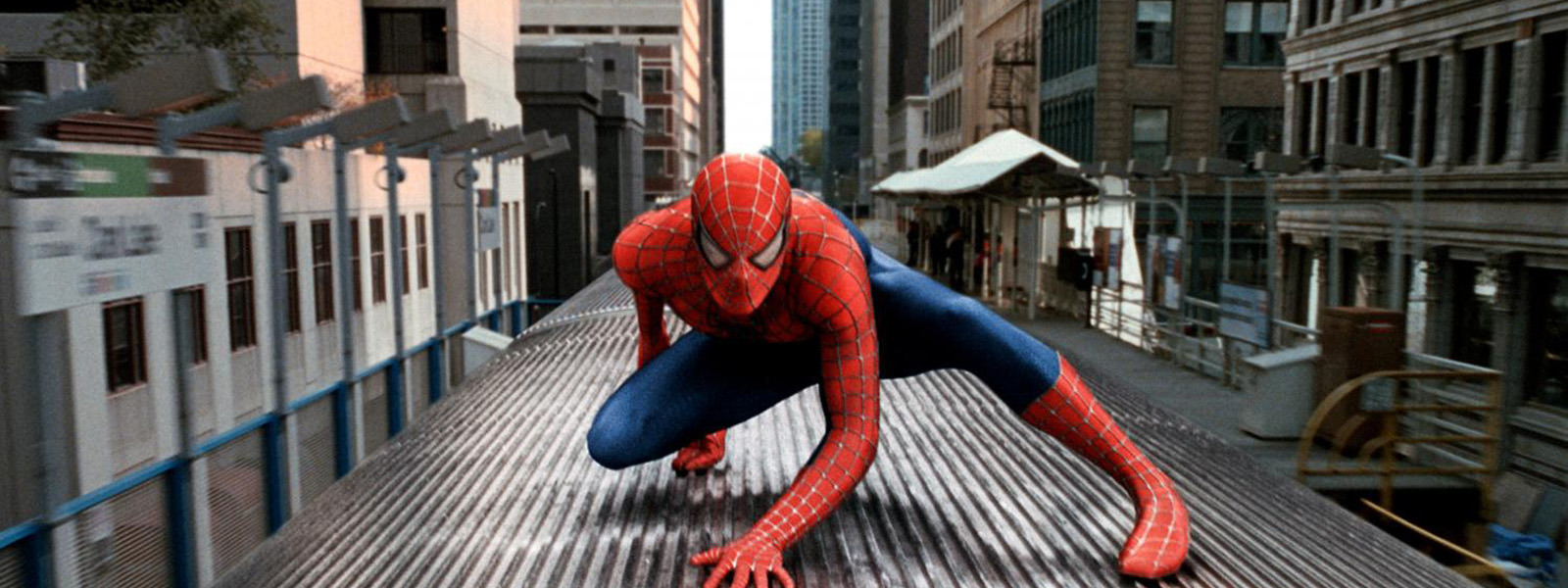
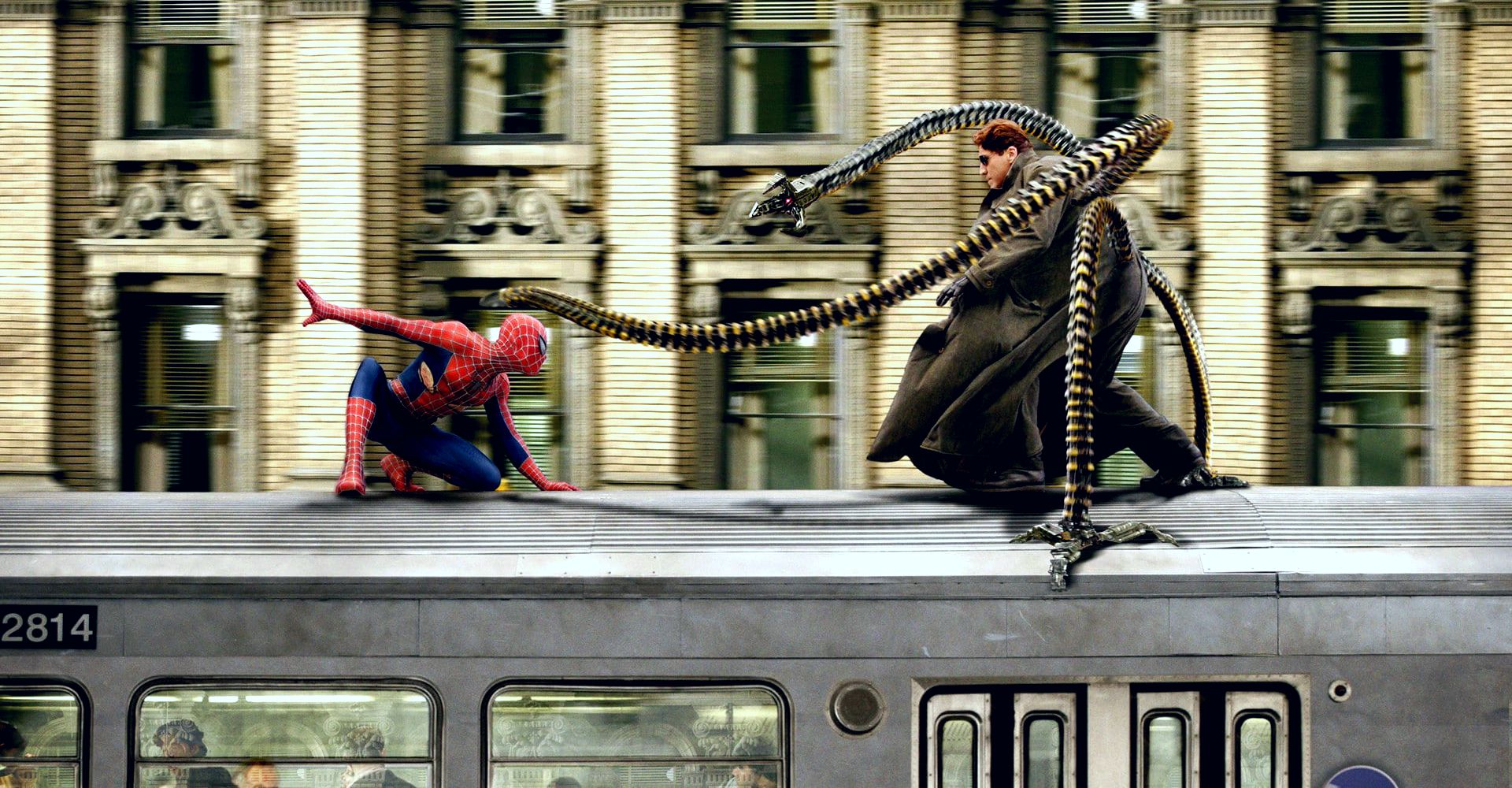
The second action sequence in discussion is the train fight between Peter and Doc Ock. I mean, come on. Everyone has talked about why this scene is not only the best and most iconic action sequence of the entire trilogy, but also one of the best action sequences in the entire superhero genre and one of the best action sequences in any film. We all know that. But why is that you may ask? Well there's multiple factors into why.
Actually, before the actual train fight begins, there's so much great stuff that a lot of people tend to ignore when discussing about the fight it self. For one, the scene starts off with the iconic moment of Jameson admiring that Spider-Man was indeed a hero ("I just couldn't see it") before Spidey wips through and steals the suit with Jameson going back to his "Spider-Man is a Menace" persona with him screaming "I WANT SPIDER-MAN!!!", which then transition to a news print that Spider-Man is back before cut right open the paper as we see him swing through the city of New York, which THEN that swing turns out to be an reflection on Doc Ock's glasses, which THEN leads to a little fight on the clocktower between them before eventually leads to them to the train fight itself! "Oh MAN! I'm still geeking out about it.". But let's track back and talk about that clocktower fight a bit. As it is a great example of blending CGI and practical effects so seamlessly, utilizing the geography of the fight to the fullest extent with having it a upwards and downwards motion in where the attacks can hit, and the fighting combats that both Spidey and Ock can pull and the hard hitting effect it can have. I mean this little section of the whole final big action set piece of the film (which I know the final battle is at Otto's lab by the river, but the whole clocktower and train fight is the final big action set piece of the film) showcases the fluently and speed that the two have with how they punch, how they knock each other with whatever they have at their disposal (like when Ock throws the big clock hand at Spidey, knocking him down, before Spidey pulls it up with him and throws it back at Ock), and how much they are alike without saying anything.
All of this fun bit at the clocktower comes to end as Spidey and Ock thrust each other down from the tower and hits the train as it moves and the fight just keeps going. This is a great example of affective pacing in action. See what a lot of people don't think about when it comes discussing about action sequences in general is the pacing of it, and the one thing a lot of action sequences in modern films suffer with is they don't know how to make things flow as naturally or when to pause it in a way to let things breathe, even if its for a split second. It can lead to action sequences that go on for way too long (like a lot of fights in the Micheal Bay Transformers films) or constantly making jokes in the expanse of cutting tension of the fight at hand and making the action have no impact whatsoever (like the boring airport fight in "Captain America: Civil War"). But in "Spider-Man 2", thats not the case. Nah man, Sam and company always kept the pacing in the train fight as smooth as butter, It always knows when to keep the momentum going, but also knows when to have its moments where it can breathe for a second before it picks up again (like the moments where Spider-Man thought Ock was gone before Ock pulls an sneak attack behind and thrusts Spider-Man like a balloon).
Also this fight is just a great example of having a clear sense of location where obstacles can be thrown at you at any direction. See part of what makes one location action sequences work so well is because often times, they're in very tight positions where our heroes are often put into crossroads where everything can happen in two directions at the same time that they only have a limited ability to get make it through and fight with whatever comes from the left and right side of things. This is why fight scenes on bridges, hallways, and trains work so well most of the time. The train fight in "Spider-Man 2" works so well in that department, not only because of it's one that utilized the one location setting to its fullest potential, but it also allows for moments to be thrown off of the train while keeping everything in tact. Like when Spider-Man had to jump up, or duck down, or jump through the coming buildings that are tough to go through, or when he gets toss off the train and sliding on the driveway before thrusting him back up to get on the train, or when he has to use all his might and saving the people on the train, or even at the part when he dodges the coming train and he pulls his whole back on the window of the train he's in. The fight just has all of these incredible moments packed in it, while at the same time, offers a sense of time to breath and allows us to get invested into the humanity behind the whole back and forth punches on the train that Raimi and company delivered so perfectly.

(Pic Credit to Sony Pictures)
But even with all the cool and breathtaking action, the innovating filmmaking, and how well fleshed the main characters are, there's one aspect of this trilogy that put itself into all time great status, and it's one that a lot of people don't think about when discussing about the trilogy. Of course, I'm talking about the dozens and dozens of memorable side characters present throughout this trilogy.
Now establishing the main characters, and its villains is of course important, and as we explored throughout this essay, this trilogy does a great job on that. But I think it's equally important to establish a cast of supporting characters (no matter how big or how small their presence they may be) to not only fuels the main characters even more than they were before, but also helps makes the world around them feel real and lived in as well. There are so many memorable side characters in this trilogy that listing them will take up an essay of its own right.
Some of the most highlights of the supporting cast includes (not in any particular order): The whole crew at the Daily Bugle (J. Jonah Jameson, Robbie Roberson, Betty Brant, and Hoffman aka the best character of the trilogy), all 3 of Bruce Campbell cameos (my personal favorite of his in 3 if you're wondering which cameo I liked the most. Also it warms my heart that Sam allowed his best friend to be the first person to ever say "The Amazing Spider-Man" on screen. Like if that isn't real friendship, I don't know what is), Mr. Ditkovitch and his daughter Urusla, "Macho Man" Randy Savage as Bonesaw ("BONESAW IS READY!"), Octavia Spencer as the woman in the wrestling sign up table who calls Peter "Small Fry", Mr. Aziz (Peter's boss at Joe's Pizza), Emily Deschanel as the receptionist who goes "You're late. I'm not paying those", Joel McHale as the bank manger, the woman who screams "GO SPIDEY GO", Dr. Curt Connors (who didn't turned into the Lizard in this trilogy btw), the violin lady who sing the Spider-Man theme song (also shoutout to the guy on the guitar who also sang it in the first film), the guy who goes "Woah. He stole that guy's Pizza!", the truck driver who said "He stinks, and I don't like him", Peter's teacher at high school who is like the same age as the whole class (weird), Hal Sparks as the guy in the elevator, all of the kids Peter saved and interacts with (include the two who sees Peter doing a flip, "you know eat green vegetables"), all the civilians cheering on Spider-Man across the trilogy, the list goes on.
Raimi knows that he wanted to make these films about a boy with spider like powers, fighting a guy who wears a goblin suit and a guy who has robotic octopus arms feel grounded and real that he places so much focus on the everyday people at any chance he gets. Whatever it be through shots where regular people looking up at Spider-Man swing across the city, or constantly be present during the action sequences, or interact with our main characters at any sight, the everyday people shown in these films are important and have just as much of a character and personality to them as Peter, MJ, Harry, and Aunt May. I mean for God sakes, the "He stole that guy's Pizza" guy is more memorable and have a much more unique personality to him than anyone in the 2016 "Suicide Squad" film, and I remember the woman who screams "GO SPIDEY GO" than I remembered anyone in most Marvel films that came out in the last 10 years, and the funny thing is that these characters are there for like one scene and yet they left such a big impact on the film. And that's because of Raimi's ability to keep focus on the grounded humanity whenever they appear on screen, to contrast with the more bombastic comic book like feel that goes with the action and flying sequences.
One of the biggest problems that a lot of superhero media have these days is the lack of true connection between the hero and the city they are inhabiting in. Most of the time, the backdrops of different cites or locations the heroes inhabit in are only used for empty spaces to have them fight dozens of CGI armies with no real civilian contact at sight. Sure you can make the argument of "well, they do that so no innocent people get can hurt and makes it a less of a stressful thing the heroes have to deal with", but that goes against the whole concept of why superheroes exist. So they can protect and care for the ordinary people who don't have super powers. People like you and me. Not to mention that if the attention is by focusing just on the super powered people either fighting with each other or a huge army of CGI creatures, it doesn't have a sense of level of grounded humanity when you don't have an ordinary person there in danger for the hero to take their time to save them in the middle of the bigger fight they are apart of. Now this isn't to say there aren't scenes or moments where they interact with the every day people, there are a good amount of them every now and then. It's just they're not as prominent as they should have been and are only there to fill up the background for the characters to walk in when they're needed to be.
But in this trilogy, Sam throws so many people across different boards in different locations at different times to make Peter understand that there are people living in the city of New York with their lives, families, and friends at personal stake at hand, and he needs to protect them, no matter the cost or anything that's going on in the battles they're facing with. Throughout the trilogy, we get to see Peter interact with the everyday people of New York in so many scenes. Whatever it might be through his mundane life or as Spider-Man, Peter's interaction with the common people is what helps build that raw humanity spring out within these films, and helps make us care about New York City as much as we do as the main characters.

(Pic Credit to Sony Pictures)
I mean many of the best moments of the trilogy come from the everyday people coming about to help Peter at his lowest moments and show that no matter crummy, or messy, or unsettling things might be, there are still good in this world. Like the moment in the first "Spider-Man" where the citizens really together and throw things at the Green Goblin as Spider-Man is trying to save both MJ and the kids on the bridge ("YOU MESS WITH SPIDEY, YOU MESS WITH NEW YORK!" "YOU MESS WITH ONE OF US, YOU MESS WITH ALL OF US!"), or the moment in "Spider-Man 2" after the train fight and Peter uses all of his might to stop the train and the people on the train recused him after he passed out ("He's just a kid. No older than my son") and telling him that things are going to be alright , or even a smaller and more personal moment like when Ursula offers a piece of chocolate cake when Peter is at the lowest point of his life and Peter was like "That would be nice". It's moments like these is what really makes this trilogy special, because Sam understands that we all want to be the best version of ourselves and always be a hero to those who need someone to lean towards. Even on days where we feel lost or confused, and want to give up on everything. Besides, you can't have a friendly neighborhood Spider-Man without a friendly neighborhood to be there, can ya?
It's even more apparent when you take in consideration that these films came out after 9/11 (with the first film came out roughly around a year after the event it self), and so many people felt lost, confused, worried, and hopeless about the state of America at the time. Constantly asking ourselves, "will we ever get better?" during those darkest of moments. So by having scenes and moments where our attention is gazed towards the everyday people (people like you and me), and see them expressing those feelings of confusion and anger yet also moments of pure happy and joy, it helps makes the city of New York in this trilogy feel believable and makes you want to live in it. Not because you can see Spidey swinging around the city, but because you want to be feel inspired and feel like you too can be a hero in your own life, and be there supporting and help Spider-Man no matter what. And to quote MJ in the third film, "Everybody needs some help sometimes, Peter. Even Spider-Man."

(Pic Credit to Sony Pictures)
Okay. So I have talked about the filmmaking, characters, and everyday people presented within this trilogy. Now I want to drive your attention to the themes and tone within this trilogy, because I think this trilogy does a great job of handling them effortlessly.
Let's start with tone. I have mentioned this early on in this essay, but these films are cheesy and silly as hell. I mean it's a story about a boy who gets super powers of a spider and fights villains like a guy in a goblin suit, and a guy who is literally made out of sand. How much more cheesy and silly can you possibly get? And yet it wears that tone with no shame to it whatsoever, and that's because of Sam's ability to not only commit to that tone and feel that was presented in those early Lee and Dikto comics, but make it apart of its identity and never looses the heart and realness behind it. So because of that, it was even branched off to having different tones at different times and not feel like they come off as tonality incoherent at the slightest.
Like one scene can be serious and dramatic (like when Peter remembers Uncle Ben after his high school graduation and how much he missed him in "1"), another one can be scary and terrifying (like the hospital scene in "2"), another one can be silly and campy as hell (like the "Drive that Funky Soul" montage in "3"), another one can be beautiful and romantic (like Peter and MJ's upside down kiss in "1"), another one can be thrilling and exciting (like Peter recusing Gwen from the falling building in "3"), another can be comedy gold and makes me laugh so hard (like the "Raindrops Keep Falling In My Head" montage in "2"), you get my point. The whole trilogy is filled with scenes are different in tone and feel, and is still feel like some form of tonal cohesion within each film, and that's because of Sam's ability of capturing real human emotions in the most authentic way possible. Making all the different tones feel perfectly placed without being undercut or not properly sinked in. As well as knowing when to have these different times and when not to have them undercut the importance of what's going on in the bigger picture.
See, one of my biggest problems with a lot of modern day films (especially in the blockbuster/superhero relm), is how many of them strive for that constant need of having so many different tones being placed at once, praying that they can appeal to every single people who payed their time to see the film and say "Hey. You like this genre and such? We got all of that in our film. Please enjoy it.". But the problem start to lies when you're constantly trying to uncut the importance of a scene by throwing a different tone than the one that's established. Thus, it creates a sense of disconnect and not trusting your audience with being committed in feeling one authentic emotion (whatever it might be happy, sad, funny, scared, etc) at any given moment. Like how is the audience is supposed to take things seriously, when your film can't take itself seriously? Think Hollywood!
But that's where the magic of the Raimi trilogy comes into play. What makes the tone shifting work in the trilogy is that Sam and company always (and I mean ALWAYS!) leave space for these scenes and tones to play out and make sure the sincere emotion of any given scene stays in that space without anything coming out of nowhere to ruin that moment. And even when different tones do come into the same scene, it always plays as an extension to the committed tone of that scene without making it feel so jarring.

(Pics Credit to Sony Pictures, and collage was done by yours truly)
To understand my point, let's talk about the scene in "Spider-Man 2" where Peter and MJ are connecting through the backyard as an example. Not only is this scene one of my favorite scenes of the film (and of the trilogy as a whole), and such a great callback to their first conversation in the first film, but this scene is a great example of how you combine different tones and keeping things feel consistent at the hand.
The scene starts off with Peter taking out the trash from Aunt May's home after Peter's birthday party and he noticed MJ saying "Hey" to him from her backyard and Peter was surprise that she still here. Then from that, we start to see the two catching up and chatting about their lives in a fun banter like type of way. With MJ talks about seeing posters and billboard of her face across the city kinda embarrassed her (which she mentioned that she was meant to be in the catalog, but the photographer liked her face that she made it to the front cover), and how she got the part of the play, showing that her dream of being an actress have came true, just like Peter said it would. While Peter on the other hand, is doing fine himself (or at least he tells himself that) and is planning to see MJ's play, since he hadn't gotten the chance to yet.
But as the scene goes on, the fun banter between them starts to die down and starts to become more serious and intimate. As Peter is struggling to tell MJ what is exactly going on with his life, because you know, he's Spider-Man and he originally pushed MJ away at the end of the first film that makes it feel a bit awkward to talk to her about what's going on. Meanwhile, MJ is trying to get Peter to open up to his thoughts and what's going on, so she can connect to him on an emotional level, and we see that being played out not emotionally, but also visually as well. We see as the two get closer and closer, Sam and Bill gets closer within how slowly the camera moves and the extreme close ups on Peter and MJ's faces shows the longing and yearning both of them want to have with each other, but simply can't, due to the lack of them actually communicating on how they feel towards one another on an emotional level.
It's because of that, Peter and MJ goes back to distancing from each other as MJ tells Peter that she's somebody now. Which Peter casually replies, "Oh. Therapy.", but MJ combats that statement by clarifying that she's seeing a man and she likes him. Leaving Peter in a state of confusion for a brief moment, and try to brush it off by saying "that's good. You know, companionship." (he's dying inside, #relatable!). But the scene ends with a more a hopeful note when Peter tells MJ that he's going to her play, and we see MJ being happy that he's coming and praying that he doesn't disappoint her by not showing up, and Peter responding with "I won't.".
This scene is a great an example of how you can have two different set of tones play in the same scene and still feel tonally consistent, because there's a sense of true sincerity beneath it all. It doesn't try to be all self aware of it, or make a joke about it at the slightest. Nah man, it plays the moment as straight and as honest as it can be, because they come from true human emotions that can we can feel one way and feel another during the same period of time, and Sam knows how to take a moment like Peter and MJ talking in the backyard seriously while incorporating a bit of light humor in the mix, and have it steamed from the characters being honest with their feelings rather trying force it when it doesn't need to be. If more films can take notes from this trilogy and understand that you can have different tones in your movie naturally without being forced or manufactured, then movies would be a better experience to watch you know.

(Pic Credit to Sony Pictures)
Now let's shift our focus on the themes presented throughout the trilogy. But in order to understand what the themes in the trilogy are, we have to understand the controlling idea behind it. If you're not familiar what the term "controlling idea" means, it can be described as:
"a one-sentence statement of the story’s ultimate meaning expressed through the action and aesthetic emotion of the last act’s climax." - Industrial Scripts
Basically, the controlling idea is expressed through how the choices of the story, characters, and themes essentially connect back to the main idea it wanted to share by the end of it all, and the controlling idea of the Raimi Spider-Man Trilogy can be summed up with this iconic line: "With Great Power, Comes Great Responsibility." Or in a more deeper analytical approach to it, "With being a hero and a good person, you must be willing to be responsible with the power you have. Even if it means to make the hardest choices in your life"
And that controlling idea is present throughout the course of all 3 films. In the first film, it was about Peter gaining his new set of powers and learns what does it mean to be responsible with those set of powers despite the hardships he faced with (like the death of Uncle Ben, and not being with Mary Jane at the end). The second film is about Peter trying to balance his hero life and his normal life, and is struggling to balance them equally, and leads to him to make the choice on which side of him should he be more responsible towards. And the third film is about Peter being too controlling with the power he has, and needs to let go of that in order to be a good and emphatic person. I might have done a bad idea of explaining things (I apologize in advance), but you get the idea (hopefully). That controlling idea is the basis for every choice with the story and characters throughout the trilogy that even branches to many themes that were explored in each film.
Themes like choice, discovering empathy, power, responsibility, forgiveness, finding and accepting oneself, sacrifice, abandonment, vengeance, hatred, and being understandable and compassionate towards those around you. And that's just to only name a few of the themes explored in the trilogy. Because this trilogy does a great job of exploring and diving into those themes in such elegant and nuanced ways. Whatever they're communicated through dialogue, or subtule visual cues, or the choices the characters make, they all connect to the trilogy's core ideas and themes and how each film builds upon them in an organic matter and have every plot thread and character choice that was set up at the beginning conclude by the end of it all in way that felt natural (yes, even despite the studio influence that happened in "3", it still naturally continued the themes and ideas presented in the first two), while at the same time do things differently to make them work as satisfying stand alone experiences. And that's something really hard to pull off in a trilogy like this (and the great Patrick H. Willems made a great video on why a lot of trilogies don't always work that you should check out for yourself), but Sam, David, Alan, and everyone who worked on this trilogy knew how keep the controlling idea intact throughout the course of all 3 films (that being the whole great powers, comes great responsibility odeal) and thus making the whole experience of watching the trilogy satisfying by the end. Which is one of the many reasons why this trilogy works so well in the way does, in a way that many trilogies falter.

(Pic Credit to Sony Pictures)
And now it's time to get more personal. I have spend so much time about how the trilogy works so well within every aspect a film should accomplished, but I want to get to the root of it all. I want to talk to about how this trilogy has meant to me on a personal level, and how they helped me to become the person I am today. Bare warning, this might have some triggering content as depression and suicide. So if you don't feel comfortable reading this section, scroll down to a later portion of the essay. I'm not forcing you to read this part and I get why you might not want to. For everyone else tho, let's talk about it.
I've briefly mentioned this in my Taylor Swift post awhile back (which you should read it if you haven’t yet), but throughout my whole life, I have been dealt with a lot unhappy emotions in my mind. From anger, to anxiety, to stress, to depression, and a lot of factors come into why I have these emotions. It's because of places like school and work, or a big moment that affects my family as a whole (liking moving from my childhood home and family members passing away), or dealing with different relationships that I don't know how to handle in an affective manner, all that jazz. And because of all that, I start to feel like a tool for whatever comes into the foreplay.
A tool that needs to achieve the "perfect standard" that's impossible to achieve. It lead me into a path of depression and even thinking of committing suicide. I was constantly thinking back of the choices I made that I regretted, how they affected myself and the relationships I had with other people, and I was often alone. Constantly asking myself "Why the fuck am I here? Why has God put me on this earth just so I can go and fuck everything up like everyone else in the world?", saying things like "I'm just a bad person who's better off alone with no around me" and constantly putting on a mask, telling everyone that I'm fine, when deep down I wasn't. It was like everyone expected me to be something that I wasn't, and I was ready to quit it all.
But it wasn't until pretty recently I realized that I can't live in this angry and depress bubble that I was in any longer. So I had to do something that I know it's the hardest thing for anyone to do. Admitting that I wasn't emotionally well. I talked to this my family and friends about it, and they were shocked that I was feeling those things. But thankfully, they were loving and supportive of me wanting to be a better person, and they have given me the tools to help me become a better person like seeking therapy and finding healthy outlets to express my thoughts in a healthy manner like what I'm doing right now.
And for the first time, I start to feel like I was truly happy. Not the fake happy sort of deal, but the happiness that felt true to me, and one I didn't care anything (or anyone) wants to tear me down and such. It's a reminder that I have been throughout of shit in my life, and while I may not be perfect at keeping things consistent and no matter that life can and will sucks, I might not let those anger, stress, and whatever negative feelings I'm having to bring me down and always try to be a better person every day.
So with all that being said, I bet you're wondering what does my life story have to do with the Raimi Spider-Man trilogy. Well it's because I saw my self in these films, and most notably within this take of Peter Parker. He's someone who has dealt with a lot of emotional bages, struggles with making his two lives work in one unit, feel into his sins and hurts the people he cares about (whatever intentionally or not), and is constantly doubting himself if he's a good person. But even despite all of that, he still manages to get back up and do the right thing while remaining that good kind hearted person he always is (much like Aunt May said to him after Peter admitted to that he hurt MJ and she tells him to forgive himself for what he has done).
You might have no idea how this means so much to me, especially now. Which I know you might make fun of me for saying that I saw myself in a film about a boy getting spider powers, but these films felt like a mirror was put up to me and said "hey, this is you" both the good and bad, without judging at me at the slighest. I saw myself in Peter's struggles and in his happiness. I saw my parents believing in me, loving me for who I am, and giving the advice I need to be a good person through the way Peter interacts with Aunt May and Uncle Ben and the impact they have on Peter. I saw myself in Peter's desire to be with Mary Jane and understand what real love is. I saw myself in Peter's way of building empathy and compassion towards others, and that has helped me to be more emphatic towards the people around me who might have gone through something similar as I did. I get reminded that being sometimes we have to make the hard choices in life in order to do what's right, even if means giving up the things we want the most, even our dreams through Peter's arc in "2". I mean can go on, but these films showcases the best version of myself and the version I want to inspire to be everyday.
And I think that's why we, as a society, can connect to Spider-Man as a character overall. It doesn't matter who's under the mask, it doesn't matter if we're reading the stories on a page or watching on screen, it doesn't matter what medium these stories are being told, everyone in some way or form can relate to Spider-Man. Through these stories, through his world, through everything he does, we can find ourselves through him (whatever it's Peter Parker, Miles Morales, or whoever is under that mask). He represent our flaws, our insecurities, our desires to be happy, the hardships we face, the losses we have to endure, the day by day life we have to live with, the doubts we may have if life is worthing continuing, the struggles to find the balance in everything we have in our lives. But even through all of that, he represents as a reminder that no matter how much life can and will suck, that we must get back up and always do the right thing (even when its hard), and inspire to be a better hero/person to those around us. Because as Aunt May said it best, there's a hero in all of us, that keeps us honest, gives us strength, and make us noble.

(Pic Credit to Sony Pictures)
I want to end this essay by talking about the final scene of "Spider-Man 3" (and the final scene of the trilogy overall), which is not only my favorite ending amongst the 3 films, but also my favorite ending to any comic book/superhero film and one of my favorite film endings period. And why this ending sums up my love for this trilogy as a whole.
The scene starts off with Mary Jane singing at the jazz club she works at, talking about how she’s threw with love after the experience she had gone through in this film and doesn’t want anything to do with it. But as she sings that song, Peter walks in and gets a glimpse of her singing front and center (a nice callback to where MJ references that she wants to spend the rest of her life singing on stage with him in the first row), before MJ noticed him and stops singing the song about being threw with love. Peter and MJ gives one look at each other before Peter stretches out his hand to dance with MJ. She acts all “really Pete? You want to do this”, before she agrees to take his hand. Now the two go from being a bit distanced from each other (with MJ on stage, and Peter not being on stage) to seeing them face to face in the middle of the club. That same club where Peter hit MJ under the influence of the symbiote and where everyone saw it happened. That same club where Peter finally understood that all the terrible shit happened in the film, happened because of him.
But now, it’s just the two of them with no distractions. They give a look at each other with Peter giving his remorse of everything he put her throughout the film (and the whole trilogy for that matter) without the need of saying anything, and MJ coming in to hold him tight as she could with tears on her face, signaling that Peter has owned up to the shit he did and wants to be serious about their relationship this time. All of it being beautifully conveyed without having the two saying anything at all. And as all of this happens, the two dance the night away. Not in a fun sparky way, but a slow yet tender dance where things will take its time to sow up again and it shows how they really need each other. No what happens, Peter and MJ needs that comfort within their relationship and this dance showcases that beautifully. It shows that Peter has always love MJ, and MJ has always love Peter. No matter what.
This scene makes me cry every time. Every. Single. Time. Not only the scene itself is absolutely beautiful, but this scene is the perfect capper of what this trilogy really is at the root of it all. It's a human drama focus on the inner complex emotions of being a hero and a human being that so happens to have superhero action in them. Yeah, even when you strip the superhero flashy stuff out of the equation, you get a trilogy of a young boy learning what does it mean to be a good man not just for other people, but more importantly himself.
It’s amazing to me that this trilogy ended where it started. With Peter Parker catching his eye on Mary Jane Waston. Except now, he’s gone from just being the boy who got bitten by a spider, to being a man who has grown to have empathy and compassion towards others while learning more of what it means to be a hero. While I didn't love "No Way Home" like everyone else did, one thing I did love about it is how subtly sates that Peter and MJ DID managed to work things out after the events of this trilogy, and that warms my heart, because it shows that while everyone is flawed and may not always be kind to each other, if you truly love someone and want to do everything to care for them, then you should own up to your mistakes and grow true compassion and empathy towards others. That's what love is, and the final shot of MJ and Peter taking things at ease with each other and the value and love they have for each other can convey things better than anything I can ever say about it.

(Pic Credit to Sony Pictures)
I have been working on this blog post for a little over a year now (it was an on and off project, due to things like school, work, and other things that got in the way to get it sooner than later), so I don't know what else is there to say. Sure there's probably details I may have missed and such, but I at least touched on the big points as much as I can. All I have left to say is this:
The Sam Raimi Spider-Man Trilogy is no doubt the best superhero/comic book film trilogy (in my opinion that is), and one of the only 3 film trilogies in where I have given all 3 films a 5/5 rating towards on Letterboxd (the other 2 being "The Before Trilogy" and "The Lord of the Rings Trilogy"). The impact this trilogy had on cinema and the superhero trilogy is insane. I doubt the genre would be at the place its at if Raimi and everyone who worked on the trilogy didn't put all the hours and hard work into making all 3 films as entertaining, as exciting, as heartfelt, and as emotionally moving as they were.
But perhaps more importantly than the impact it had on cinema, The Raimi Spider-Man Trilogy has left an impact on the lives of millions of people, especially mine. Throughout all 3 films (especially "Spider-Man 2", which is my favorite film/work of art of all time), I found myself in every aspect of this trilogy, both as a lover of film and as human being. Not only being amazed by the expert craftsmanship within the directing, cinematography, editing, score, and action sequences and knowing how to study film on a deeper level, but I found myself for who I am as person through the way all 3 films makes the story, characters, and themes feel real and human, to where I start to see the best version of myself in these films. Like I don't think I would be here today if weren't for these films. They are one of the few pieces of art that go beyond the limitations of their respective mediums, they helped shaped me into the man I was meant to be. And that's the power of truly exceptional art that will stand against the time.
Of course, I'm totally fine with people not being a fan of this trilogy and such. But I hope after reading this very long, messy, and personal post pouring my love for the trilogy, that maybe you might give them a revisit and see if your perspective has changed. Who knows, may be you can see the beauty behind it all and why so many people including myself loves them to death. And to the people who loved this trilogy already, I hope this post can help respark that love and be a reminder why the trilogy might have left a big impact on you. I mean if this post hasn't given enough why I have been obsessed with this trilogy like they're my own children on social media and why I will endlessly re watch them when there's a like a million of other films to watch, then, I don't know what will.
The only thing I have left to say is. To Sam Raimi, Tobey Maguire, Kirsten Dunst, Danny Elfman, Bill Pope, and everyone who has worked on this trilogy in some way or form, I just wanted to say Thank You. Thank you for making these amazing set of films that captures the spirit of those Spider-Man comics so perfectly while being your own thing. Thank you for changing the game for superhero media and become a gold standard of what those pieces of media can be. But more importantly, thank you for making these amazing films that define so many people lives including myself, and inspire us to become a better person. These are films that I will endlessly re watch, talk about, and obsess over for as long as I live.
"Whatever life holds in store for me, I will never forget these words: "With great power comes great responsibility." This is my gift, my curse. Who am I? I'm Spider-Man."
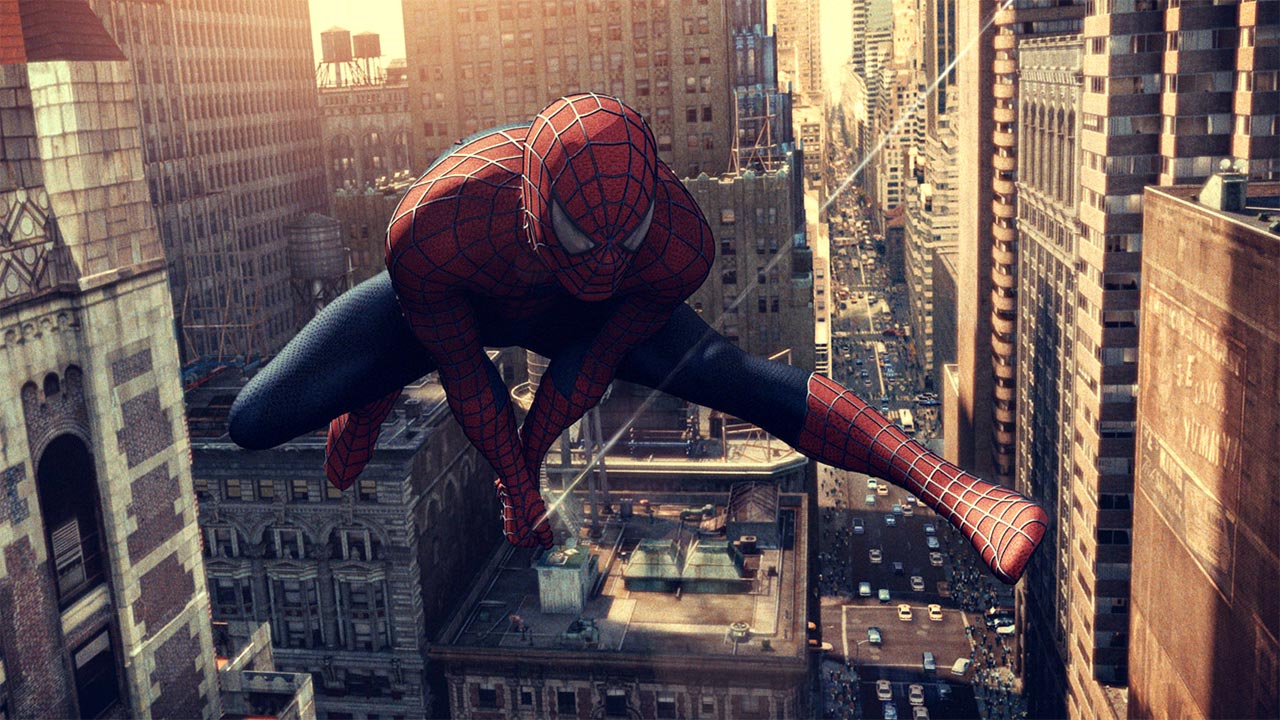
(Pic Credit to Sony Pictures)